AI
AI Automation for Small Business: Why 'Not Relevant to Us' Is a Fair Answer
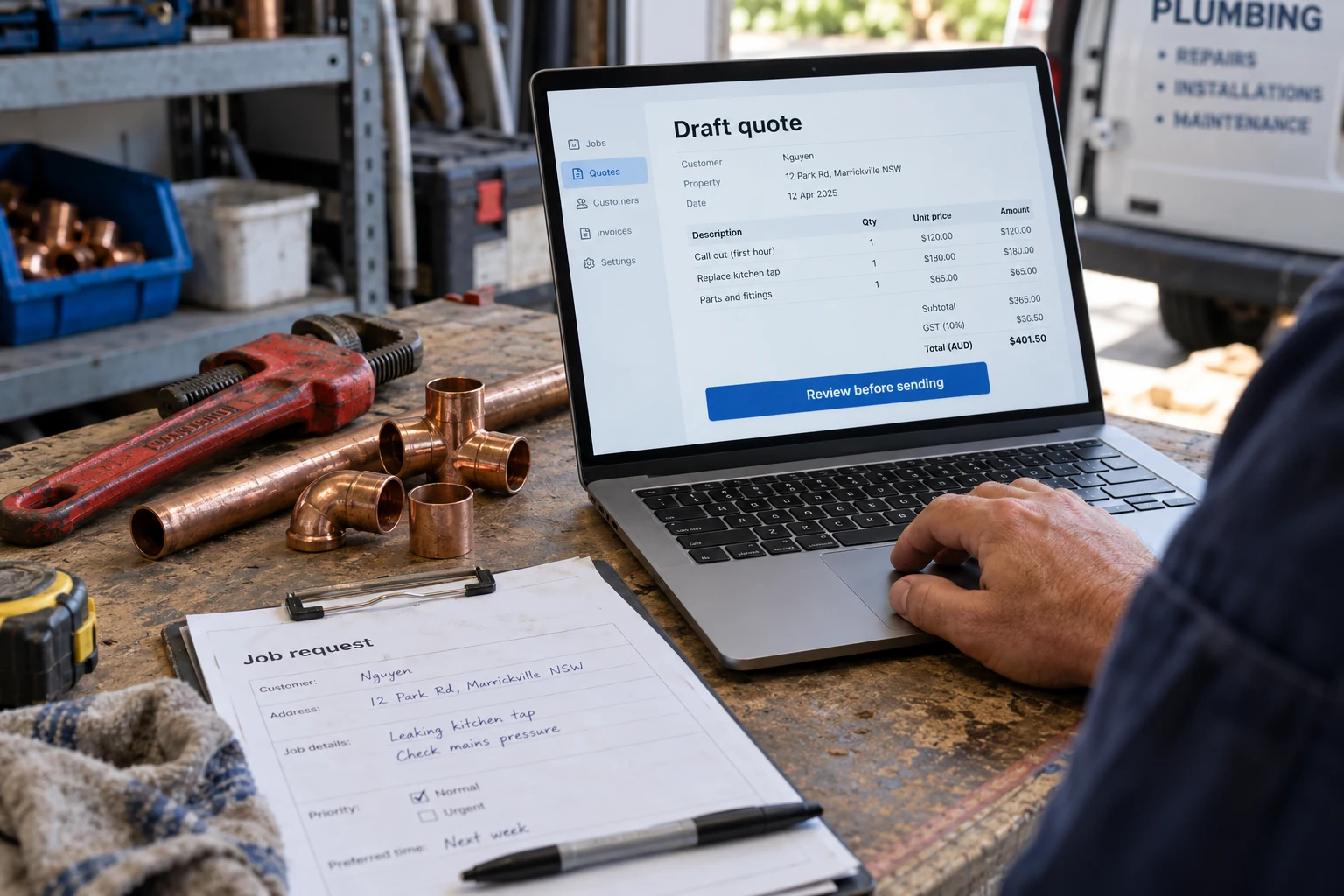
If you run a business with fifteen staff and have decided AI has nothing to do with you, the evidence backs you up more than the marketing suggests.
Among Australian SMEs that have not adopted AI, 54% say it is "not relevant to this business". That figure comes from the National AI Centre's SME AI Pulse, covering December 2025 to February 2026.
Only 19% of non-adopters say they do not know how to use AI. Many businesses have looked at AI and still cannot see a clear connection to how their operation actually works. That is a fair response.
The problem starts when "not relevant" becomes a final judgement on the technology itself, rather than a judgement on how AI has been presented to the business.
Key Takeaways
- 43% of Australian SMEs reported some level of AI adoption between December 2025 and February 2026, reaching 44% in February, the strongest month in several months.
- 54% of non-adopters said AI was not relevant to their business, while around 65% cited distrust of AI decision-making or a preference for keeping humans in control. Only 19% said they simply don't know how.
- Common AI applications among adopters — content generation, data analytics, cybersecurity — sit alongside existing processes rather than changing how the business runs.
- The practical starting point for AI automation is the workflow, not the tool.
The pattern across those figures tells its own story. This is not a business population that has rejected technology outright. It is a business population that has not yet been shown where the technology fits into the way they already operate.
Source: National AI Centre, SME AI Pulse (Fifth Quadrant), December 2025 – February 2026.
"Not Relevant" Is Often a Verdict on the Pitch
AI automation can sound much bigger than it needs to be.
At a practical level, it means applying AI to a specific step in a business process. That could involve classifying information, drafting a response, extracting data or routing an enquiry, with a person remaining accountable for the outcome.
The challenge is that AI is often marketed as a general capability. It can write, summarise, analyse and classify. The business owner then has to work out where those capabilities fit into their existing operation.
For an eighteen-person plumbing business, that could mean looking across dozens of weekly processes and asking which one AI could actually improve. Most owners do not have time to solve that translation problem, so "not relevant" becomes an understandable answer.
The scale of who this affects is worth naming. At 30 June 2026, Australia had 2,814,778 actively trading businesses, including 232,912 with 5–19 staff and 68,325 with 20–199 (Australian Bureau of Statistics). Businesses under 20 employees make up 97% of all actively trading businesses in the country (ASBFEO) — roughly 300,000 employing businesses, each running its own set of processes, none of them served by a pitch that stops at "it writes things".
What Are Businesses Actually Using AI For?
The applications gaining traction are the easiest to understand. Among SMEs using AI, 54% report using it for content generation, 54% for data analytics, and 48% for cybersecurity and threat detection.
These sit alongside existing processes without requiring major change. The bigger opportunity comes when AI is connected to a specific workflow rather than used as a standalone tool — and that requires starting somewhere different.
Source: National AI Centre, SME AI Pulse (Fifth Quadrant), February 2026.
Start With the Workflow, Not the Tool
Before looking at AI products, look at the process. Ask four questions.
1. Which step takes the most time for the least judgement?
Look for repetitive work such as quoting, moving information between systems, invoice follow-ups, rostering or triaging enquiries. If the process can be explained clearly to a new employee in five minutes, it may be worth investigating.
2. What does the process produce, and who checks it?
Define the output and identify the person responsible for reviewing it. A human checkpoint matters when the result reaches a customer, affects money or influences an important business decision.
3. What happens if it gets something wrong?
A misclassified internal file may be easy to correct. An incorrect quote sent to a customer can have a very different consequence. Start with processes where mistakes are manageable and easy to review.
4. Who owns the system afterwards?
The business should own its accounts, credentials, documentation and relevant source materials — not the agency that built it. Make this a condition of the engagement from the start, not a favour asked for at the end.
Run through these questions and you will usually reach one of two outcomes: a specific process worth investigating, or confirmation that there is nothing worth automating yet. Both outcomes are useful.
See our AI & Workflow Automation service
When AI Automation Does Not Make Sense
There are situations where keeping people firmly in control is the right approach. Businesses operating in regulated industries, handling sensitive information or working under a client's compliance requirements may need additional safeguards.
The level of human involvement should also depend on the decision being automated. Automating the assembly of information for a quote is different from automating the decision to send that quote to a customer.
Around 65% of non-adopters point to trust as the reason they are holding back, and roughly half of current users already check AI outputs before those outputs reach a customer. Those two figures belong together — that checking discipline is what makes current adoption defensible.
One limitation in the data is worth flagging. The SME AI Pulse surveys a minimum of 400 SME owners and decision-makers each month, rather than following the same group over time, so small movements in the percentages should be treated carefully.
Common blockers we see in SME operations
Frequently Asked Questions
Isn't AI automation only for larger businesses with dedicated IT teams?
No. What a business needs is not an IT department but someone who understands the process and can take ownership of the outcome. For a fifteen-person business, that might be the owner or operations lead.
We tried an AI tool and it didn't stick. What went wrong?
Most likely it was introduced without being connected to a specific part of the existing workflow. When technology is wired into work employees already need to complete, its value becomes easier to see and harder to ignore.
The Short Version
"AI is not relevant to my business" is a sensible response to a pitch that has not connected the technology to how the business actually operates. Look at the workflow before you dismiss the category.
Holdrix handles the tech, you focus on growth.
Want a second pair of eyes on which part of your business is worth automating first? Book a consultation.
Which step in your business should you automate first?
Talk to the Holdrix team for advice and find the right solution for your business.