AI
Anthropic's New Claude Usage Policy: What It Means for Businesses
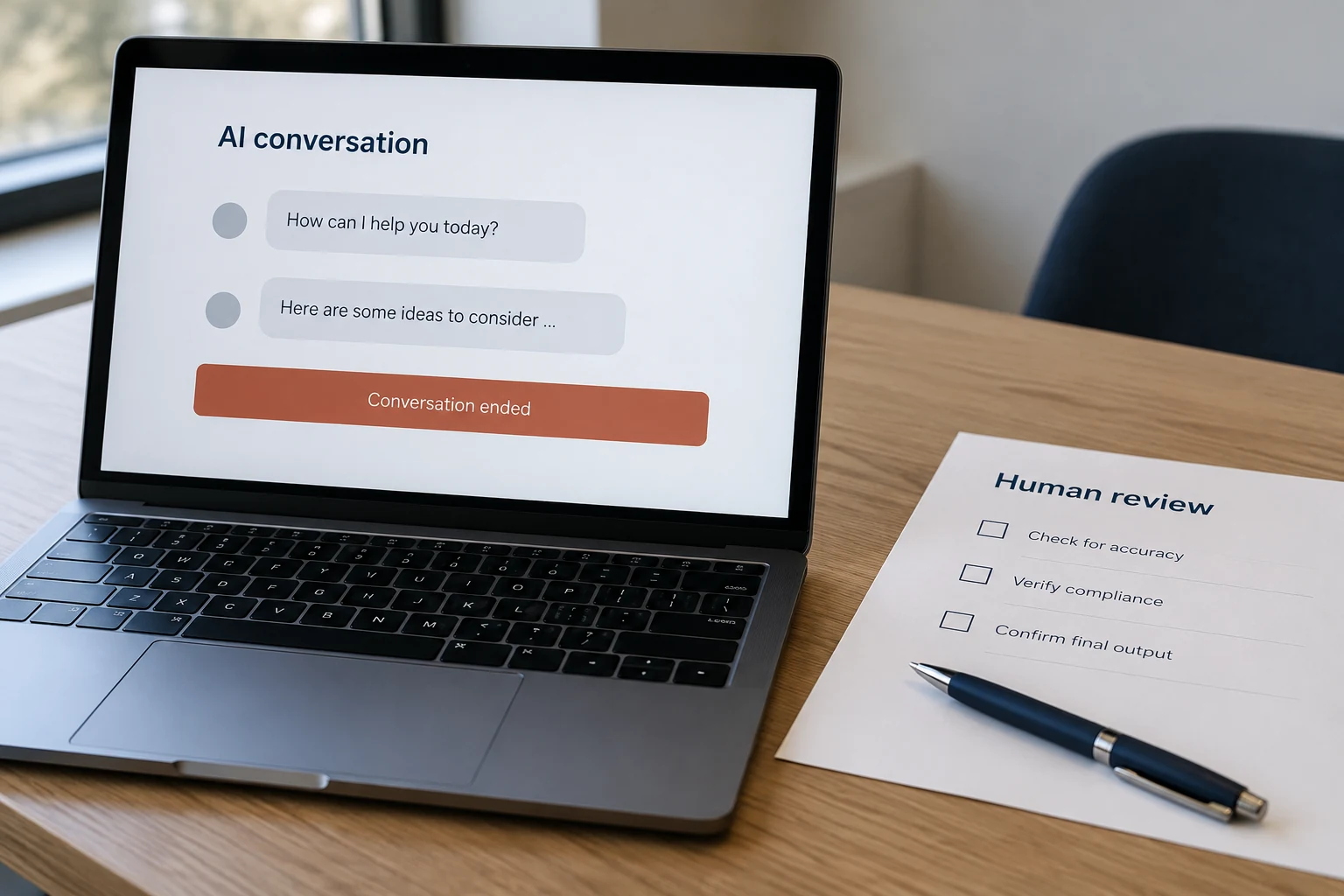
Anthropic has updated Claude's Usage Policy, adding a rule against sustained, pointless abuse of its AI models for the first time. For businesses, though, the bigger changes sit elsewhere: fake-account campaigns, human oversight, and AI connected to physical equipment.
On 8 October 2026, Anthropic published the new version of its policy, effective 12 November 2026. Anthropic says most of the changes clarify existing rules. The headline addition prohibits “sustained and needless abusive or cruel behavior” toward its models.
Key Takeaways
- Claude's new Usage Policy was published on 8 October 2026 and takes effect on 12 November 2026.
- The abuse rule only covers extreme cases; frustration, pushback and model testing remain allowed.
- The main enforcement tool is Claude ending the conversation, a feature Anthropic introduced in August 2025.
- Businesses should note the ban on fake accounts and content, including for commercial purposes, and the human-oversight rule for high-stakes decisions.
What does the new rule actually cover?
Anthropic says the rule is aimed only at extreme cases, where someone is repeatedly cruel “with no discernible purpose”. Everyday situations are fine, even when the user is clearly annoyed.
Still allowed
- Venting when Claude gets something wrong
- Pushing back and asking for another attempt
- Testing limits and researching the model
- Creative writing with dark themes
May breach the policy
- Repeatedly berating the model for no purpose
- Sustained cruelty after Claude has tried to redirect
- Extreme abuse that serves no work or research goal
Summarised from Anthropic's announcement of 8 October 2026.
On enforcement, Claude's ability to end a conversation remains the primary tool, on Claude.ai and Claude Code. Once a chat is ended, no new messages can be sent in it, but other chats are unaffected and a new one can be started straight away.
Anthropic has not said whether repeat offenders could lose their accounts. The Register also questioned how Anthropic will tell legitimate frustration apart from gratuitous cruelty.
The background: research into “model welfare”
In August 2025, Anthropic gave Claude Opus 4 and Claude Opus 4.1 the ability to end some persistently abusive conversations, as part of its research into AI model welfare. In pre-release testing, Anthropic observed that Claude Opus 4 showed a consistent aversion to harm and apparent signs of distress when users kept pressing for harmful content.
Anthropic is explicit that it remains “highly uncertain” whether Claude or other large language models have moral status. It frames the feature as a low-cost precaution, used only as a last resort after several attempts to redirect the conversation have failed.
Source: Anthropic, “Claude Opus 4 and 4.1 can now end a rare subset of conversations” (15 August 2025) and the usage policy update (8 October 2026).
Does being rude get better answers?
One reason some people take a harsh tone with AI is a study published in October 2025 by Om Dobariya and Akhil Kumar at Penn State. Across 50 multiple-choice questions rewritten in five tones, from very polite to very rude, ChatGPT-4o scored 84.8% accuracy on the rudest prompts against 80.8% on the most polite.
The authors themselves note it used a single model and a small dataset. In day-to-day operations, what decides answer quality is context and a clear brief: the purpose of the task, the input data, the output format and how the result will be judged. A prompt that covers those does far more than any change in tone.
The changes businesses should check
Beyond the abuse rule, the new policy adjusts several areas that bear directly on how businesses use AI in marketing, customer service and operations.
1. Deceptive campaigns and artificial activity
Rules that used to be spread across several sections now sit in one: do not engage in deceptive campaigns or artificial activity, “whether political or commercial”. The policy bans hiding who is behind a message, amplifying content through fake accounts or posts, and building tools for influence operations. According to MacRumors, that includes fake reviews and bots posing as humans.
2. High-stakes decisions need a human in the loop
For products that affect health, legal rights, finances, livelihood or access to essential services, the core requirement is unchanged: a qualified person must review and be able to change the AI's recommendations, and the affected individual must be told AI was used. The new version spells out more clearly which recommendations are in scope.
3. AI that controls physical equipment
Where Claude is connected to hardware that acts on its own and could cause injury, a qualified operator must be able to watch it and stop it. The equipment must also hold a safe state if Claude disconnects.
4. Tracking and surveillance
Tracking people without consent is banned, whether in real time or by analysing data already collected, as is building surveillance tools. Consented uses such as fraud monitoring, content moderation, journalism and legal research remain allowed.
What should a business do before 12 November?
Most small and medium businesses will not need to change much. These four steps make for a quick review of how you use AI today.
1. Review marketing work that uses AI
Check reviews, comments and social accounts. Every piece of content should make clear the business is behind it, with no fake accounts to inflate engagement.
2. Identify the high-stakes decisions
List where AI feeds into decisions about money, jobs or customer rights, such as screening job applicants or approving credit terms. Each one needs a person who signs off.
3. Say when AI is involved
For those decisions, customers or staff should be told that AI played a part.
4. Write a short internal guide
One page on writing clear prompts, which tasks AI may handle and who checks the output helps staff use AI well and within policy.
See our AI & Workflow Automation service
What the policy does not change
You can still tell Claude it is wrong, ask it to try again or probe its limits. Anthropic also stresses that most changes clarify rules it was already enforcing rather than adding new restrictions.
Businesses using Claude through a third-party tool should read the full Usage Policy and check that provider's terms as well.
Common blockers we see in SME operations
Frequently Asked Questions
Can you lose your account for being harsh with Claude?
No, not for ordinary frustration or pushback. The rule targets sustained cruelty with no discernible purpose, and the main enforcement tool is Claude ending that conversation. Anthropic has not published details on account suspension.
When does the new policy take effect?
Anthropic published it on 8 October 2026. It takes effect on 12 November 2026 and applies to users of Anthropic's products and services.
What should businesses using Claude for marketing watch?
Do not use Claude to create fake accounts, posts or reviews that amplify a message, or to hide who is behind it. The rule covers commercial activity, not only politics.
The Short Version
The rule on being cruel to Claude only bites in extreme cases and barely touches everyday work. What businesses should review is AI-assisted marketing, high-stakes decisions, and where a person checks the output.
Holdrix handles the tech, you focus on growth.
Want a second pair of eyes on how your business uses AI? Book a consultation.
Sources
Is your current use of AI right for your business?
Talk to the Holdrix team for advice and find the right solution for your business.