Operations
Why Australian Small Businesses Get Paid Late — and What Actually Fixes It
If you spend part of every week chasing payments, it is easy to conclude the answer is chasing harder. The data suggests that is rarely where the problem sits.
Average payment terms have sat still at 29 days for three reporting cycles. The slowest end, though, keeps stretching: the 95th percentile payment time moved from 58 days to 64 (Payment Times Reporting Regulator).
That part you do not control. What happens before the invoice goes out, you do — and that is where the effort actually pays.
Key Takeaways
- Average common payment terms have held steady at 29 days across three reporting cycles.
- The average proportion of invoices paid within 30 days has improved by 6.6 percentage points since the first reporting cycle.
- But the slowest payments got slower: the 95th percentile moved from 58 days to 64.
- The spread between industries is wide — public administration and safety reached an on-time payment rate of 76.4%.
Read together, those figures describe something other than a few difficult customers. They describe a default market condition that small businesses have to operate inside.
What the Numbers Actually Say
Two trends are running in opposite directions, and looking at only one of them gives the wrong picture.
The encouraging half: the average proportion of invoices paid within 30 days has improved by 6.6 percentage points since the first reporting cycle, and average common payment terms have held at 29 days across three cycles (Payment Times Reporting Regulator, published 24 August 2026, covering 1 July to 31 December 2025).
The other half: the slowest payments are getting slower. In its February 2026 update, the Regulator reported that the 95th percentile payment time — the slow tail — moved from 58 days to 64 (February 2026 update, covering 1 January to 30 June 2025).
If you are a small supplier, the average does not describe your life. The tail does.
The gap between industries is worth noting too. Public administration and safety reached a 76.4% on-time payment rate — which means that level is achievable; it is just not evenly distributed.
The scheme applies to large businesses, which must report every six months on their payment times and terms to small business suppliers (Treasury). You can look up individual entities, and it is worth doing before signing a large contract.
The Symptom Is Cash Flow. The Cause Is Usually Earlier Than the Invoice
When a payment runs late, the reflex is to chase harder. Chasing only acts on the last stage. In many small businesses, the money was already stuck well before that.
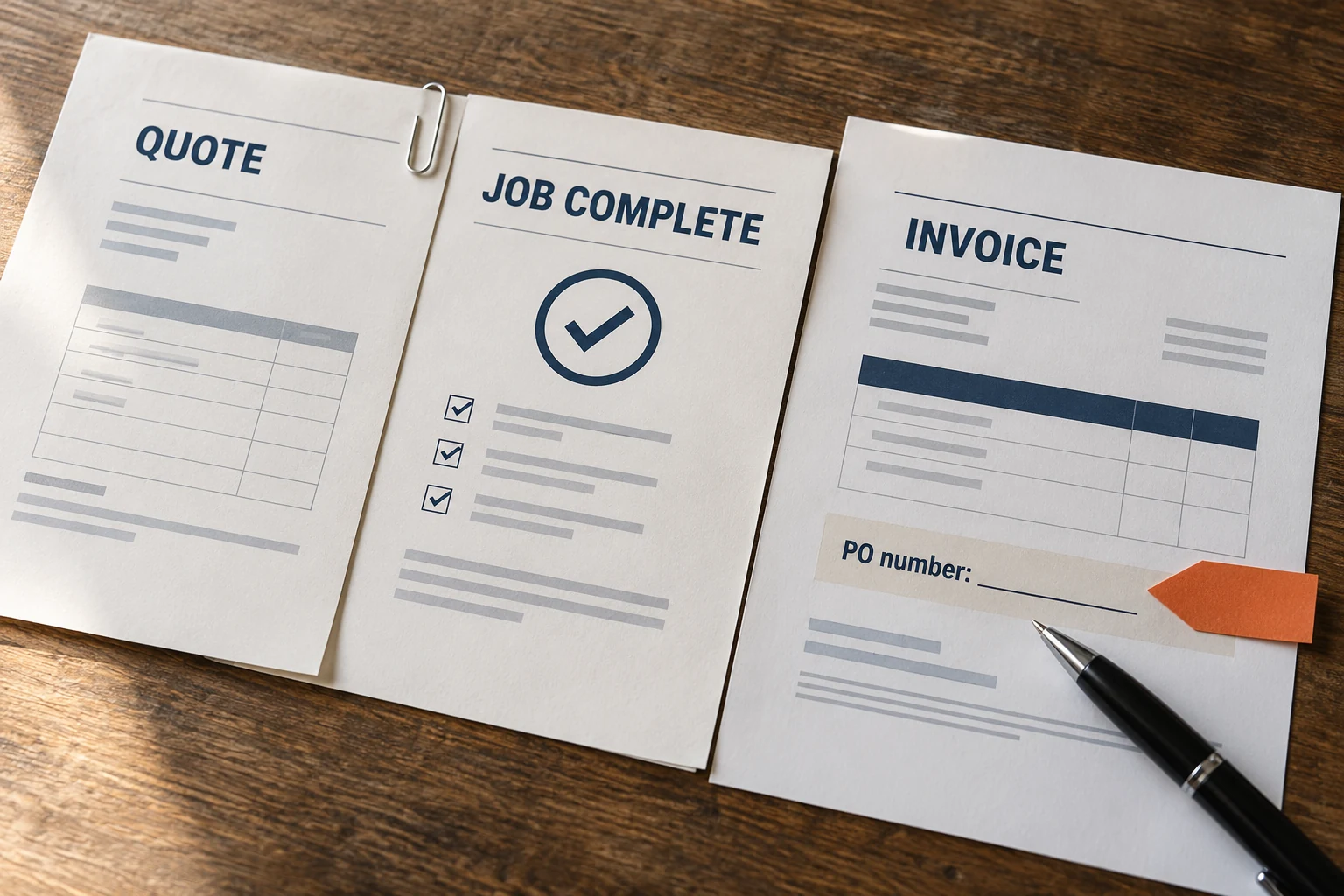
An invoice usually stalls for an unglamorous reason: a missing purchase order number, the wrong legal entity, the right contact but not the person who approves, or a description of the work that does not match what was quoted. The payer does not refuse it. They set it aside.
Nobody tells you. You find out when it is already overdue, and by then it rejoins the queue at the back.
Four Places a Payment Actually Stalls
Before looking at software, walk back from the last payment that ran late and find which of these four it stopped at.
1. At the quote
Does what you quoted and what you invoiced describe the same thing in the same words? If they differ, whoever approves it has to go and ask — and asking costs weeks.
2. At the job record
Who confirms the work is complete, and with what? Photos, a signed docket, a checklist. If the evidence lives in one person's phone, it cannot travel with the invoice.
3. At the invoice
Does the invoice carry everything the other side needs to approve it first time — purchase order number, correct legal entity, the accounts inbox rather than your day-to-day contact? Reaching the right person is not the same as reaching the right process.
4. At the follow-up
Can you see which invoices are overdue without opening folders one by one? If not, the chase will always start late.
The first three are where most of the time goes, and they are the three that get touched least.
See our AI & Workflow Automation service
What Fixing It Involves
It is usually not a new system. It is usually making one existing thing run the whole way: quote, job record and invoice drawing on the same source, so the wording matches without anyone retyping it.
Add one screen that shows what is overdue and by how long, and a reminder that fires before you would have remembered.
That is a small piece of work. What matters is that it acts on the first three stages, not only the fourth.
When It Is Not Worth Fixing
If you issue ten invoices a month and they get paid on time, leave it alone. The cost of a new system will exceed the time it saves.
And if your largest customer pays slowly because of their own internal policy rather than anything missing in your paperwork, software will not solve it. Contract terms or a different customer mix will, and neither of those is a technology problem.
If that is your situation, ASBFEO publishes guidance on payment times, and that is the better first stop.
Frequently Asked Questions
We already use accounting software. Isn't that enough?
Accounting software handles stages three and four well — issuing and tracking. It usually does not reach stages one and two, the quote and the job record. If those still live in email and text messages, the wording drifts and the invoice still stalls.
Should we charge interest on late payments?
You can, and many businesses write the term in. In practice it rarely makes a large customer pay sooner. It is more useful as leverage when the contract is signed than as a lever once the money is already late.
The Short Version
Getting paid late looks like a cash flow problem, but the part you control is a process problem. Walk back from the last late payment and find where it stopped before you think about what to buy.
Holdrix handles the tech, you focus on growth.
Want a second pair of eyes on where your payments are stalling? Book a consultation.
Where is your cash flow getting stuck?
Talk to the Holdrix team for advice and find the right solution for your business.